Concrete Driveway Contractor in Florence and The Shoals
We replace and build concrete driveways across Florence, Muscle Shoals, Sheffield, and Tuscumbia. Every job starts with full removal of the old slab when there is one, a compacted stone base over the clay, reinforcement in the pour, and control joints cut on a plan — because a driveway in The Shoals is only as good as what's under it. Free estimates by site visit.
Replacement, done right
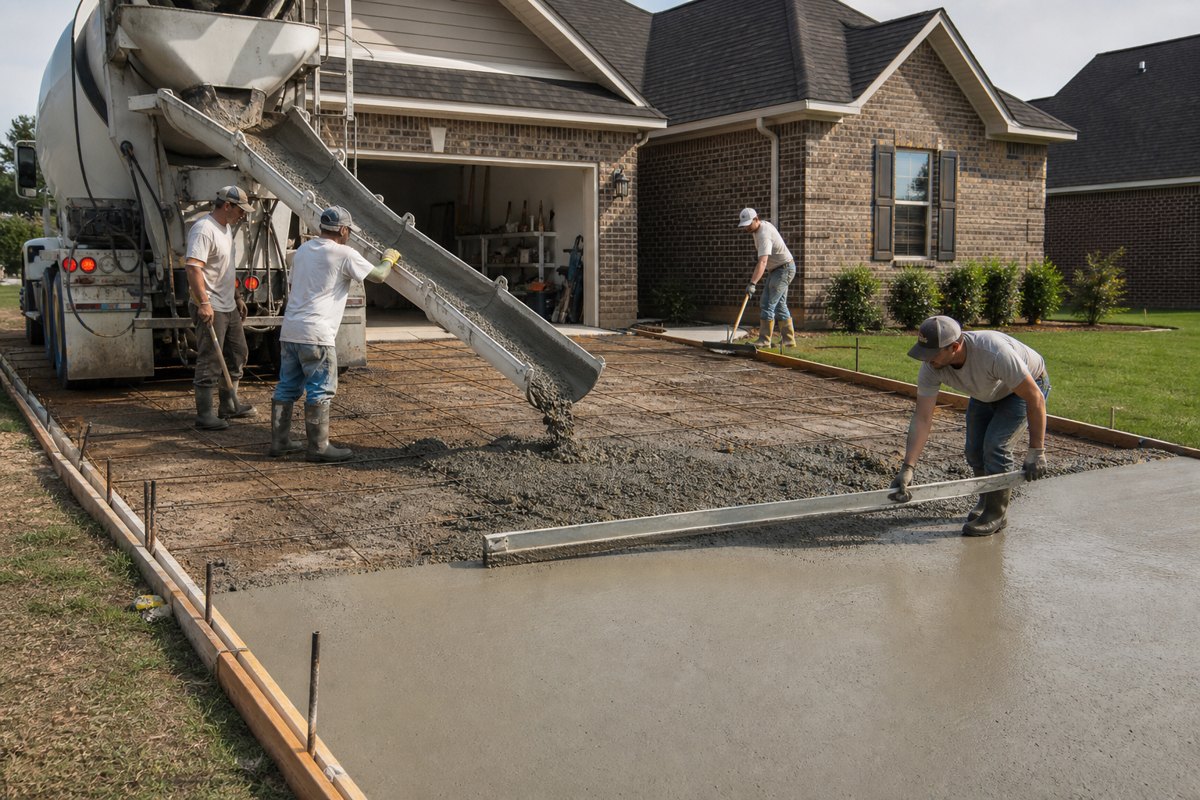
Most of the driveways we build in The Shoals are replacements — the old slab is cracked, settled into the clay, or draining the wrong way, and patching has run its course. On this site, replacement always means the same thing: the existing concrete comes out completely, gets hauled off, and a brand-new driveway gets built from the ground up. We don't pour over broken slabs, and we don't sell overlays as a way around the real work.
Removal day is exactly what it sounds like. Saw cuts break the old slab into pieces that fit the truck, excavation takes out the concrete and any soft or wet material underneath it, and then we're down to subgrade — the dirt that will actually carry your new driveway. That's the moment the job gets decided, and it's why we treat removal as part of the build instead of a chore in front of it.
From there the sequence is short: stone base spread and compacted in lifts, form boards set to the finished grade, wire and fiber reinforcement placed, and the pour itself. You see the plan at the walkthrough, and the spec we quote on the driveway — four-inch minimum slab, six inches at the apron, control joints on a spacing plan — is the spec that shows up in the truck's mix tickets.
New driveways
Building a driveway where there wasn't one gives us a clean sheet, and the first thing a clean sheet is good for is layout. We walk the site with you and figure out where the drive meets the street, how it wraps the house, where cars will actually sit, and how the whole surface falls. Slope isn't an afterthought — a new driveway is graded so water crosses it and leaves, never pools in a low spot or runs straight at the garage.
The same planning covers the transitions: how wide the drive flares at the street, where the walk picks up from it, and whether an apron at the curb line needs the heavier six-inch section. If you know a truck, a boat, or a camper will live on it, that changes the thickness plan and the joint layout before anything else gets decided — thickness is always matched to what will park on the slab, not to a one-size template.
What gets decided before a new pour:
- Layout and width — where the drive runs, turns, and meets the street
- Slope and drainage — where rainwater goes at every edge
- Thickness — four-inch field, six-inch sections at aprons and heavy use
- Joints — where control joints fall so the panel layout works with the shape
Finishes
Almost every driveway we finish gets a broom finish — the fine lines you've walked on a thousand times. It's the standard for a reason: it grips shoes and tires wet or dry, it hides the small variations that come with any hand-finished surface, and it wears like iron. A light broom is the default; we can tighten or open the texture to taste.
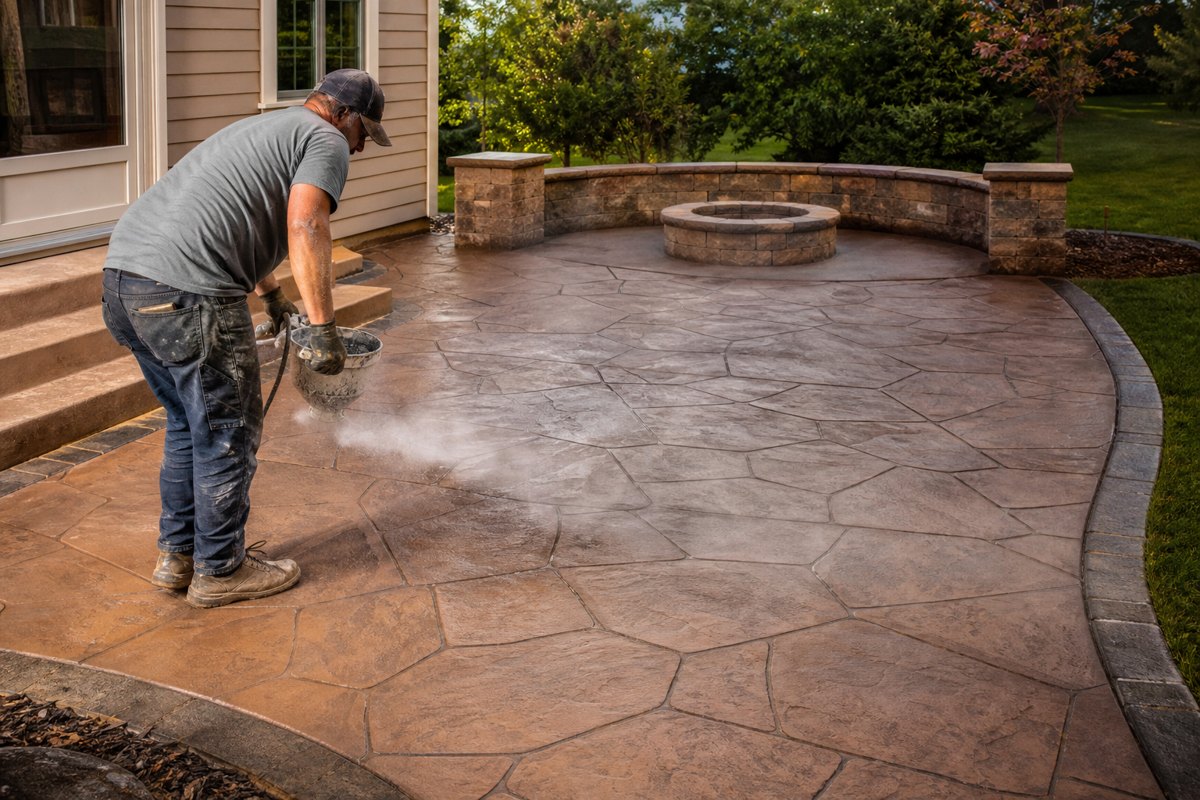
Smooth trowel finishes have their place at borders and accents, and colored or stamped concrete is on the table as an option within the driveway conversation — a stamped band along the edge, a colored pour, or a patterned section that reads like stone. If you want that look, we'll talk honestly about where it works best, how it changes sealing and upkeep, and where a plain broom field is the better call. What we won't do is sell a finish the site can't support.
Joints and drainage
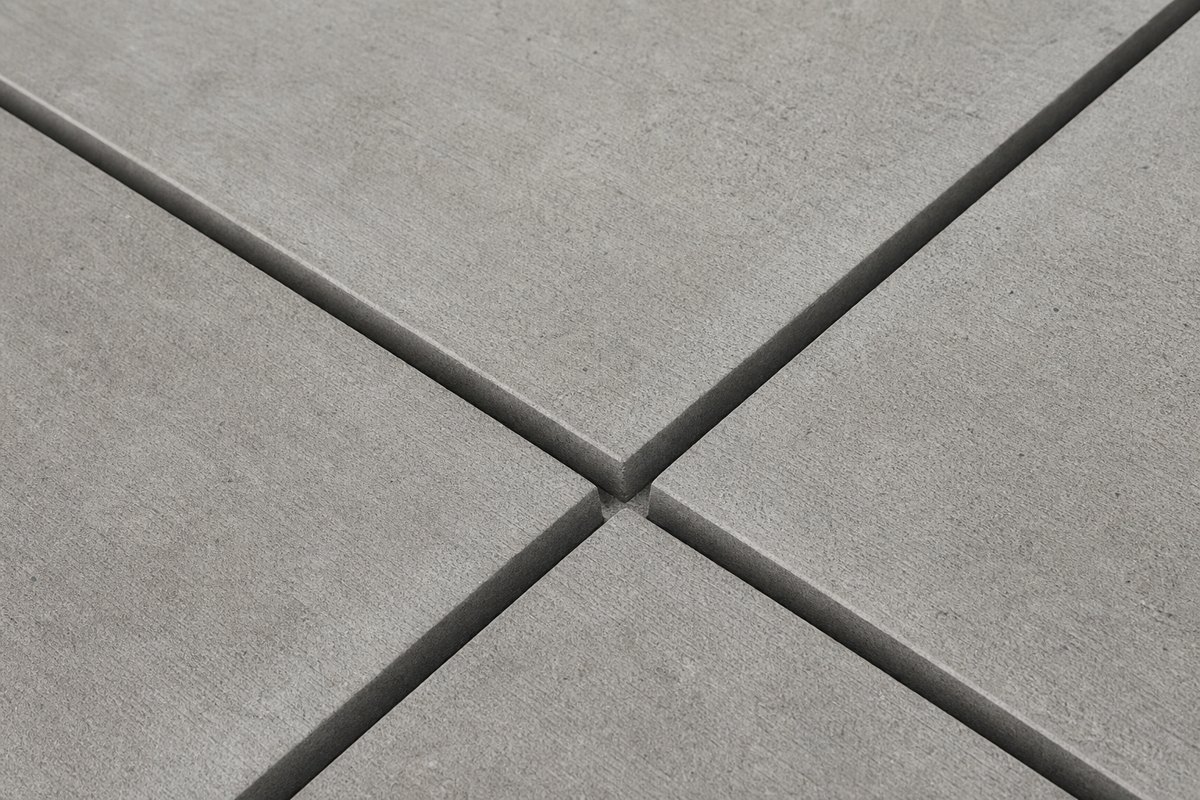
Concrete cracks. The whole trick is deciding where. Control joints are saw-cut into the slab within the cure window so that when the concrete moves — and in Shoals clay it will — the movement shows up as a straight line at the bottom of a joint instead of a wander across your driveway. Spacing follows the slab: panels are kept roughly square, and joint depth is cut to a fraction of the thickness so the joint actually works.
Drainage is the other half of the same problem. Water that stands under or beside a slab softens the clay beneath it, and soft clay is what turns hairline cracks into steps. Every driveway we plan gets graded so water sheds off the surface and away from the house and garage, and the base is compacted so it doesn't hold a bath under the concrete. Joints and slope together are most of the reason a driveway here reaches old age without surgery.
Driveway questions, straight answers
How thick will my new driveway be?
Four inches is the minimum, and we go to six inches at aprons and anywhere heavy vehicles will park. Thickness is decided by what actually sits on the slab — we talk it through with you before the pour.
How long before I can drive on new concrete?
Typically cars can go back on after about a week, and concrete reaches full strength around 28 days. We tell you the exact day before we leave your site.
Will it crack in this clay?
All concrete can crack — the answer is controlled cracking. A compacted base, fiber and wire reinforcement, and joints spaced for Shoals clay keep cracks where you never notice them.
Free estimates
Get a straight, written estimate.
Walk the site with us — we'll measure, read the drainage, and talk through base and layout for your driveway. Then you get the plan and the number in writing.
No cost, no obligation, no pressure.