Concrete Sidewalk and Walkway Contractor in Florence and The Shoals
We pour concrete sidewalks, front walks, and side paths across Florence and The Shoals — set to grade so Shoals rain crosses the surface instead of pooling, cut joints on a spacing plan, and tied cleanly into driveways, steps, and doorways. Walks get the same base and reinforcement standard as our driveways, scaled to foot traffic. Free estimates by site visit.
Front walks that work every day
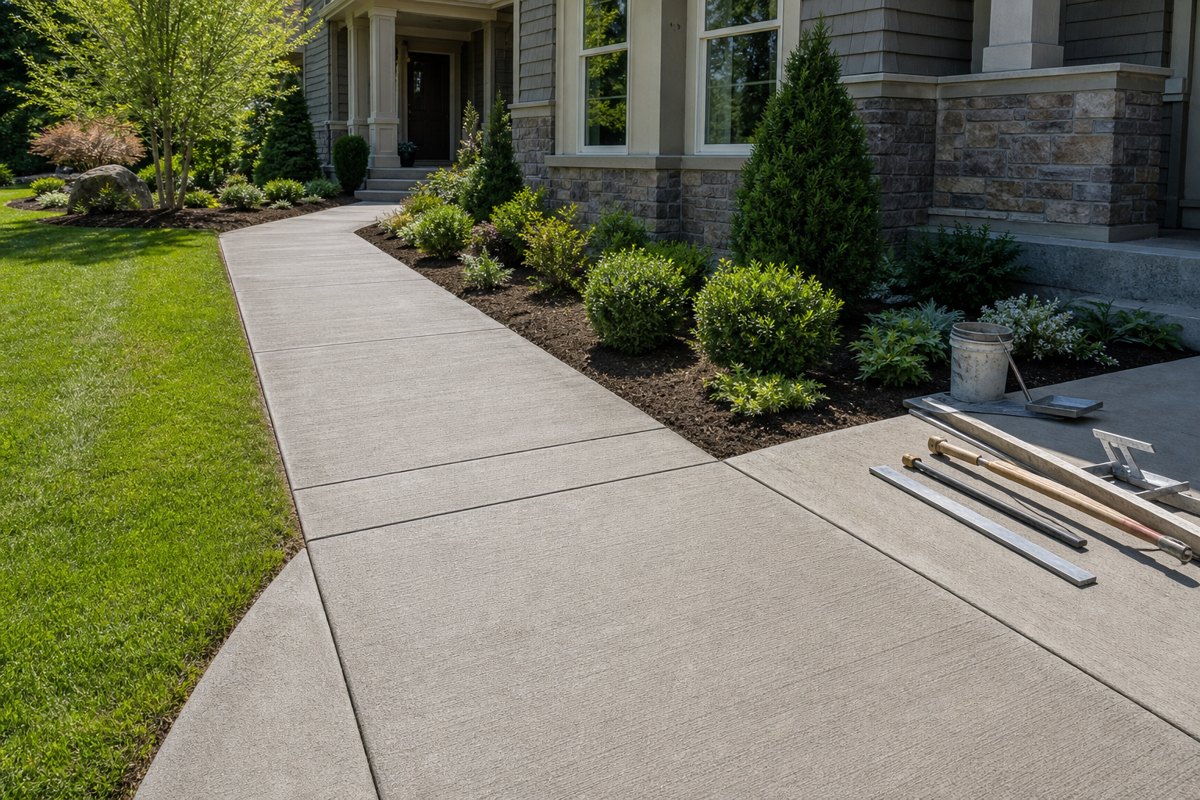
The front walk is the handshake of a property — it's the surface every visitor, delivery, and kid on a bike uses. We plan front walks for exactly that: a comfortable width, a surface that grips when it's wet, joints that fall where the walk changes direction, and a grade that carries water off without a puddle at the doorstep.
Width and line matter as much as the concrete. A walk that runs straight from the drive to the door at a width that fits two people side by side reads like it belongs; a narrow path that wanders reads like an afterthought. We lay walks out with stakes and a string line so you can walk the route before a single yard is poured.
Side paths and back routes
Side paths carry trash cans, wheelbarrows, dogs, and the mower — and they run along the foundation, where downspouts dump and grade gets lazy. A side path done right is a small drainage project: sloped to shed water away from the house, wide enough for a wheelbarrow to pass, and jointed so it can move with the clay beside the footing without cracking across the middle.
Back routes — the path to the shed, the gate, the grill — get the same treatment at a smaller scale. Where a route crosses a swale or a low corner, we set the grade so the walk crosses the water path on purpose and never dams it.
Steps, transitions, and landings
Where a walk meets a change in grade, it becomes steps and landings, and that's where layout earns its keep. Risers get kept even, landings get sized to stand on, and every step drains forward off its nose instead of holding water on the tread. A step that holds water is a step that's slick nine months out of the year in The Shoals.
Transitions to drives and doorways get planned the same way. The walk meets the driveway at matching elevation, ends at a landing rather than a drop at the door, and — where a slab meets a wooden threshold — leaves the fall the house needs so the door stays dry.
Drainage across walks
Walks cross the yard's drainage paths whether anyone planned it or not. We plan it. Cross-slope carries water off the walking surface; grade changes move water around or under the route at a swale; and where a walk has to run with the fall, we shape it so the water leaves at the first opportunity instead of riding the walk to the doorstep.
Underneath, the same standard as every slab we pour: compacted stone over clay, reinforcement in the pour, joints cut within the cure window. A walk is a small driveway as far as the dirt is concerned, and the dirt here does not care that nobody parks on it.
When the old walk has to go
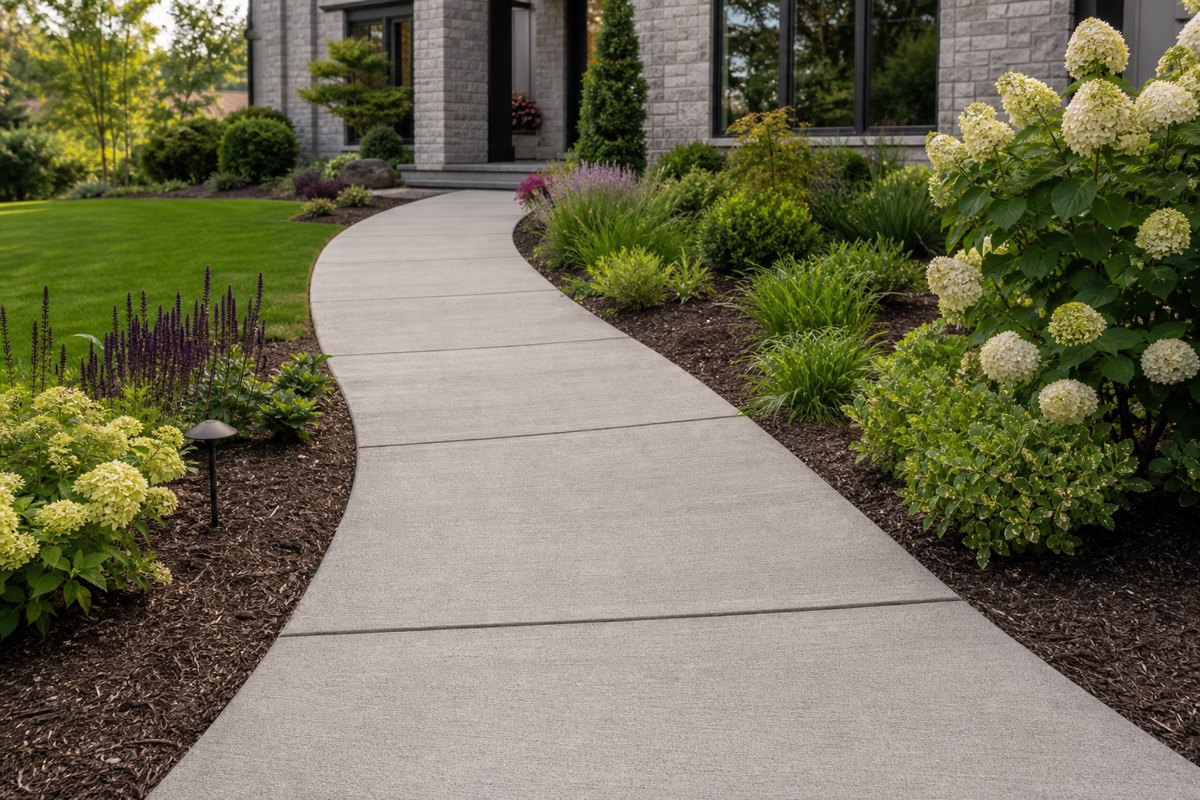
Plenty of the walks we replace across Sheffield and the older Florence neighborhoods are originals — cracked at the joints, tilted by roots, or tripping hazards at every panel. Just like driveways, replacement here means out with the whole thing: the old concrete is broken out and hauled off, the base is rebuilt and compacted, and the new walk is poured on ground that's been prepared like it matters.
Partial pours are sometimes the honest answer — replacing the failing run from the drive to the step while leaving a sound section in place. We'll tell you which one your walk is when we stand on it.
Pour day on a walkway
Walks are formed with the same boards and stakes as a driveway, set to the grade we walked at the estimate. The pour runs in one visit, the finish is broom unless the plan says otherwise, and control joints are cut while the concrete is green. Then the walk is protected while it cures — foot traffic is usually fine within a day or so, and we give you the exact timing for your pour before we leave.
Because walks are small, the parts that decide how they age — base, grade, joints — are even more of the job than the concrete itself.
Free estimates
Get a straight, written estimate.
Walk the site with us — we'll measure, read the drainage, and talk through base and layout for your walk or sidewalk. Then you get the plan and the number in writing.
No cost, no obligation, no pressure.